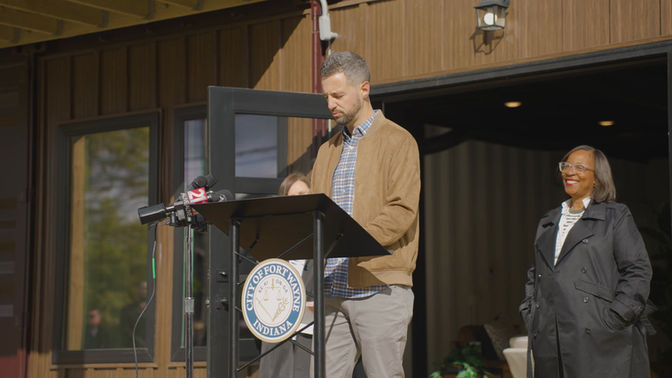
We're the development partner for nonprofits and municipalities building attainable housing. Our in-house team takes your project from land and funding to finished units, using cutting-edge, factory-built systems. Every home we build grows the local economy.
Partners in the workCity of Fort WayneHabitat for HumanityBridge of Grace MinistriesIndiana READI 2.0
Who we partner with
Most of the land waiting for new housing in Fort Wayne is infill: one lot here, two lots there. The nonprofits and cities that own it rarely have a development and construction team in house. That's the gap we close.
Nonprofits
You have the mission. We bring the build.
You know the families and the neighborhoods. We bring the development and construction capacity, so your team stays focused on the people you serve.
Attainable and workforce housing
Scattered-site and multifamily projects
Homebuyer readiness through a home readiness provider
Also building with small builders who put up 15 homes or fewer a year and want to use panels, post-frame, or containers without the learning curve. Talk to us
How a partnership works
One contract and one in-house team, accountable from the first conversation to the final unit. You stay in charge of the mission. We handle the development and the build.
1
Discovery
We learn your goals, your land, your funding, and your community, then tell you honestly what's possible.
2
Development plan and funding package
Site plans, the right building system, a real budget, and the funding stack, including grants and city programs, ready for your board or council.
3
Build and deliver
Our team manages the manufacturers, crews, and schedule, then delivers finished units backed by 2-year and 10-year warranties.
How you can hire us: as your developer, your development partner, or your construction manager, depending on what your project needs. Meet the team
Partnerships that delivered
One city and one nonprofit, each with a team that took the work from idea to finished units.
Municipal partnership
City of Fort Wayne
Innovative Housing Showcase
The challenge
The city wanted to test new ways to build attainable homes on infill lots.
What we did
Developed and built four homes, each with a different construction method, and published every cost.
The result
All four completed and presold to Habitat for Humanity buyers.
Three things every family and every partner wants to know: what it costs to build, what it costs each month, and what it costs over a lifetime. Here are the real numbers, and what they mean for you.
$204 to $229 per square foot, with real energy bills.
Four homes, four construction methods, real costs. Every figure comes from what we built and what the owners paid.
The technology behind the numbers Our current work uses structural panels and post-frame.
Guardian StructuralStructural panelsInsulated panels for a tighter, more efficient home.New Energy HomesPost-frameA kit-built frame designed for low energy use.Built at the ShowcaseContainerSteel modules built in a factory while the foundation goes in.
Home
Size (SF)
Build cost
Per SF
January energy
Structural panel
1,800
$367K
$204
$172.76
Container
1,600
$340K
$213
$169.72
Post-frame
1,200
$272K
$227
$171.80
Modular
1,488
$341K
$229
$445.31
Showcase average
$218
Typical Fort Wayne-area home
~$270
Energy is the January 2025 electric plus gas bill; the modular home is all-electric. Typical Fort Wayne home: NIPSCO's projected January 2025 bill for an average residential gas customer ($137.79) plus Indiana Michigan Power's average residential electric bill at 816 kWh ($132.06, 2024 analysis; rates have risen since). U.S. average: EIA 2025, 869 kWh and $150.27 per month. Our electric figures are the three-home January average.
Where we are now
$175 per square foot at Bridge of Grace.
Our prototypes averaged $218. Our first production project, 24 units built as one coordinated set, is at $175. And we'll be moving that bar down as we grow this movement: every project we repeat, with the same partners and the same systems, moves it lower.
In plain English: the more homes we build this way, the less each one costs.
Showcase prototypes
$218
Bridge of Grace
$175
Next
↓ lower
What it costs to live in
About $90 a month less for electricity than a typical Fort Wayne home.
Our homes use more than 50% less electricity than a typical home. That's the power that runs cooling, lights, and appliances.
Real January 2025 bills from our three Showcase homes, next to what the average home pays. Add gas, and the total is still about $99 a month less than a typical Fort Wayne home in the coldest month of the year.
Going forward, our homes heat and cool with mini-split heat pumps: one efficient electric system in place of a gas furnace and central air. The Showcase homes above were gas-heated, so expect the electric line to rise and the gas line to disappear. We'll publish the first all-electric bills when we have them.
In plain English: a family in one of our homes pays about $42 for electricity instead of $132, using less than half the power. That's $90 a month back for groceries, gas, or savings.
Per month
Our homes
Fort Wayne avg.
U.S. avg.
Electricity used
155 kWh
816 kWh
869 kWh
Electric bill
$42
$132
$150
Electric + gas, January
$171
$270
—
$90a month less on electricity than a typical home, about 70% lower
What it costs over 50 years
Metal roof and siding: about $73,000 less over 50 years.
Shingles and vinyl are cheaper on day one, then you replace them. Twice for the roof, once for the siding. A metal roof and metal siding go on once and stay. That math is why we spend more on the exterior up front.
In plain English: you'll never buy a new roof or new siding for this home. Most homeowners buy both at least once.
Shingles + vinyl siding
Day one
$22,000
Year 20: new roof
$27,000
Year 25: new siding
$22,000
Year 40: new roof again
$49,000
50-year total
$120,000
Metal roof + metal siding
Day one
$47,000
Year 20
$0
Year 25
$0
Year 40
$0
50-year total
$47,000
$73,000saved over 50 yearsMetal costs about $25,000 more on day one and pays that back at the first shingle replacement, around year 20. With no price inflation at all, metal still wins by about $15,000.
Typical 1,500 SF home, 2026 national cost guides (This Old House, Fixr, Angi). Asphalt shingles about $13,000 and replaced every 20 years with tear-off; vinyl siding about $9,000 and replaced at 25 years; metal roof about $32,000 and steel siding about $15,000, each lasting 50 years or more; replacement costs rising 3% a year. Your home and quotes will differ.
Add it up
About $195,000 saved over 50 years.
The exterior you never replace, plus the electricity you never buy. Both are measured against a typical Fort Wayne home, and both use the same 3% a year price growth.
In plain English: over the life of a mortgage and beyond, that's roughly the price of another home that stays in your pocket.
$73,000ExteriorMetal roof and siding instead of two shingle roofs and a vinyl replacement.
$122,000Electricity$90 a month less than the Fort Wayne average, every month for 50 years.
$195,000Total over 50 yearsWith no price growth at all, it's still about $69,000.
Have land, funding, or a project in mind?Tell us about it in about two minutes.
The Innovative Housing Showcase was built by more than 30 local companies who took a leap of faith on four new ways to build. Thank you.
Project partners
City of Fort Wayne
Habitat for Humanity of Greater Fort Wayne
Three Squared
Guardian Structural Technologies
New Energy Homes
Volumod
The Heartwood Group
Trades and suppliers
Air Stoppers Insulation
Allan Schmucker Construction
Apex Consulting & Surveying
Ben Schmucker Construction
Bojrab Landscape Management
BTK Communications
Chaneys Painting
Doolittle Electric
Fritcha Construction Company
Grabill Painting and Drywall
Hanford Home Interiors
Heritage Construction
Jack Laurie Group
JM Quality Construction
Living Edge
LZ Carpentry
MJM Mechanical
Momper Insulation
North American Construction Services
Ottoville Lumber
Prestige
Quality Restoration
R3B Architecture
Rock Creek Container Homes
Smith Erectors
Sublime Dezigns Remodeling and Construction
The MJ Companies
Van's Home Center
Our team
JT King
Jeff Bredemeier
Brent Kegley
Stephanie Sauer
Brett Matthews
Emilia Miles
Strategic advisorStephen Brown
The mark
A crown, a seal, and a family name.
Our seal is a new rendition of the Royal Mortgage logo my dad, Lew King, built his business under. The crown is there for the obvious reason: our last name is King. When Lew and I started Royal Developments in 2023, keeping the mark in the family felt right. The work changed, from helping people finance homes to building them, but the name over the door is the same one it was before.
We redrew it as a seal instead of a flat logo on purpose. A seal is what goes on a deed, a permit, and a finished set of plans. It means someone stands behind the work.
Navy for the work: steady and built to last. Gold for the finish: the moment a family gets the keys.
JT King
What's next
Fort Wayne is home base and will stay our main focus. The model is built to travel.
Now
Bridge of Grace
Breaking ground fall 2026, complete by May 2027.
Next
Forgotten Stones Village
With Forgotten Stones, a nonprofit that has housed more than 200 people experiencing homelessness in two years. A new two-story community for its residents, now in design, with groundbreaking targeted for October 2027.
Ahead
More infill, new communities
New partnerships on vacant lots across Fort Wayne, then bringing our development and construction model to cities and nonprofits beyond it.
Start a project
Let's build together.
Tell us a little about your project. We'll ask only what matters for your situation, and it takes about two minutes.
We review your detailsand reply within two business days.
We talk it throughon a short call about your land, funding, and goals.
You get a clear planwith next steps, timeline, and what it will take.
Credit coaching and down payment help until your credit hits 720.
2
Get financed
A partner lender
A local lender we trust gets you pre-approved.
3
Get your home
Royal builds it
We build your home and back it with 2-year and 10-year warranties.
Quick check
Two questions. Thirty seconds.
What's your credit score?
Are you pre-approved for a mortgage?
Your first step
Start with a home readiness provider
We'll connect you with a home readiness provider who can help you build your credit, make a budget, and see which down payment assistance programs you qualify for. When you reach 720, come back and we'll take it from there.
Your credit is in great shape. Next, a pre-approval tells you exactly how much home you qualify for. Send us your info and we'll connect you with one of our partner lenders in Fort Wayne.
You're pre-approved, so we can start on your home right away. Send us your info and our team will walk you through available homes and your selections.